
If you search for Ninh Binh online, you will immediately see the cliché: “Halong Bay on land.” It is a catchy marketing phrase, but as a local guide who has lived and worked in this valley for over a decade, I think it misses the point entirely.
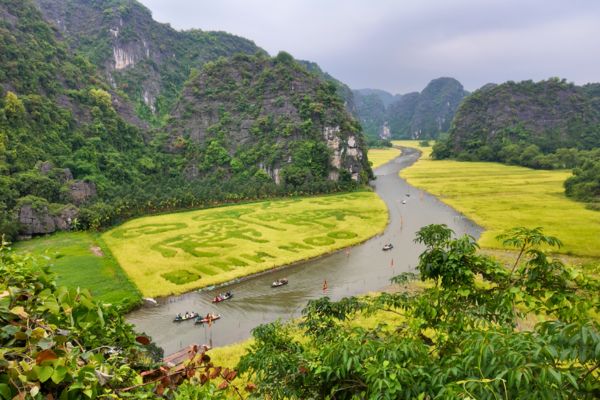
Halong Bay is a vast, mostly uninhabited seascape. Tam Coc, on the other hand, is a living, working agricultural village. When you step onto a metal sampan at the Van Lam pier, you are not just going on a sightseeing tour; you are floating right through the middle of people’s daily lives.
The internet is full of heavily edited photos and generic descriptions of this place. Today, I want to give you the honest, unfiltered truth about the Tam Coc boat ride. No exaggerated adjectives – just the practical logistics, the real culture behind the scenery, and how to navigate the unwritten rules of the river.
The Reality of the Ngo Dong River
Your journey starts at the Van Lam pier, right in the center of town. It can be loud and chaotic here. Hundreds of small metal boats are lined up, clanking against each other, while local women call out to organize the passengers.
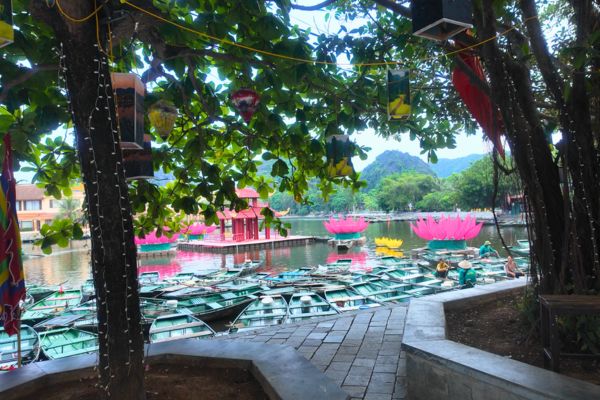
Once you are seated (usually two to four foreigners per boat to balance the weight), the chaos fades surprisingly fast. The boat pushes off into the Ngo Dong River, and within five minutes, the town disappears behind you, replaced by towering limestone cliffs and sprawling rice paddies.
The route is a straight line down the river and back, covering roughly 5 kilometers. It takes about 1.5 to 2 hours, depending on the wind, the water current, and how much traffic there is on the water.
The Rowers: Why Do They Use Their Feet?
Within the first few minutes of your Tam Coc boat ride, you will notice something that surprises almost every first-time visitor: your guide is likely rowing the boat with their feet.
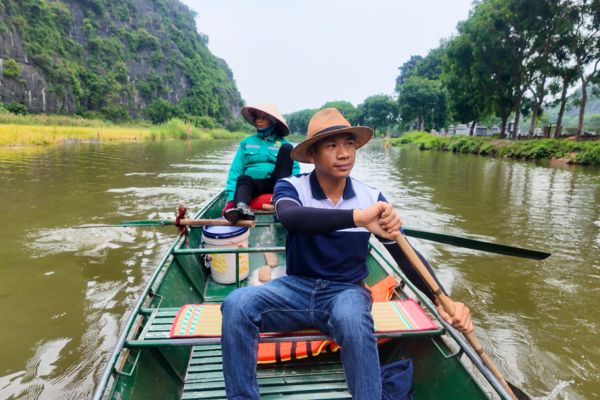
Many tourists think this is a gimmick put on for a show. It is absolutely not. Think about the biomechanics. These men and women row heavy metal boats carrying tourists for two hours straight, sometimes making two or three trips a day under the harsh Vietnamese sun. If they only used their arms and shoulders, their backs would be destroyed within a few years.
By leaning back and using their legs – the strongest muscles in the human body – they can push the heavy wooden oars with much more power and endurance. It is a brilliant, practical adaptation to a very physically demanding job. When you see it, do not just take a photo; appreciate the sheer stamina it requires.
Navigating the Three Caves
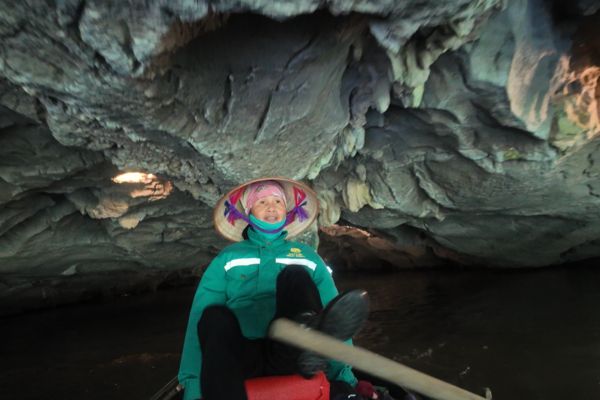
The name Tam Coc literally translates to “Three Caves.” These are natural tunnels carved through the base of the limestone mountains by the river over millions of years.
Hang Ca (The First Cave): This is the longest and, in my opinion, the most impressive cave. It is 127 meters long. As your boat glides into the darkness, the temperature drops noticeably. You will need to duck your head in certain sections to avoid the stalactites. The only sound is the rhythmic splashing of the oars and the water echoing off the low ceiling.
Hang Hai (The Second Cave): About a kilometer further down the river, you reach the second cave. It is shorter (60 meters) but features fascinating textures on the ceiling that look like rippling stone clouds.
Hang Ba (The Third Cave): The final and smallest cave (50 meters). As you exit Hang Ba, you reach the turnaround point of the journey.
Tam Coc vs. Trang An: The Great Debate
If you have limited time in Ninh Binh, you will inevitably ask: should I do Tam Coc or Trang An? As a local, here is how I break it down for my clients.
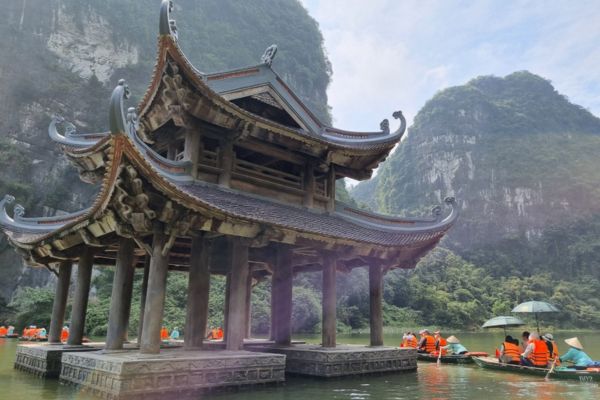
Trang An is a massive, meticulously managed UNESCO World Heritage site. It features a complex network of interconnected lakes, longer caves, and beautifully reconstructed temples. It feels very grand, epic, and highly organized.

Tam Coc is raw, agricultural, and intimate. You are floating on a natural river right next to working farmers. You will see ducks swimming by, goats climbing the steep cliffs, and locals fishing in the shallows.
Go to Trang An if you want to see an immaculate, sprawling nature park. Choose Tam Coc if you want to feel the authentic pulse of rural Vietnamese countryside life.
Timing Your Visit for the Best Experience
The landscape here changes its clothes throughout the year.

The Golden Season (Late May to Early June): This is the peak time for photographers. The rice fields turn a blinding, vibrant yellow just before the harvest. However, this window is extremely short – sometimes only two weeks before the farmers cut the rice.

- The Lotus Season (June to July): Right as the golden rice is being harvested, the water networks around Tam Coc – especially on the way to nearby Bich Dong Pagoda – explode into pink and white lotus blooms. The air literally smells sweet. This is the peak of the Vietnamese summer, meaning the heat and humidity are intense, but seeing these massive, vibrant flowers blooming directly out of the muddy water against the grey limestone cliffs is a quintessential local experience.
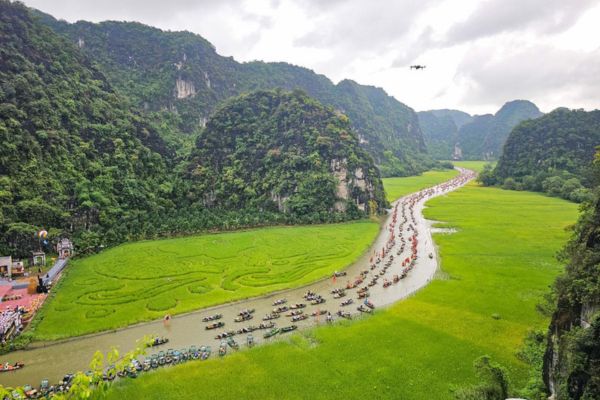
The Green Season (February to April): The fields are planted and growing, carpeting the valley floor in a lush, bright green.
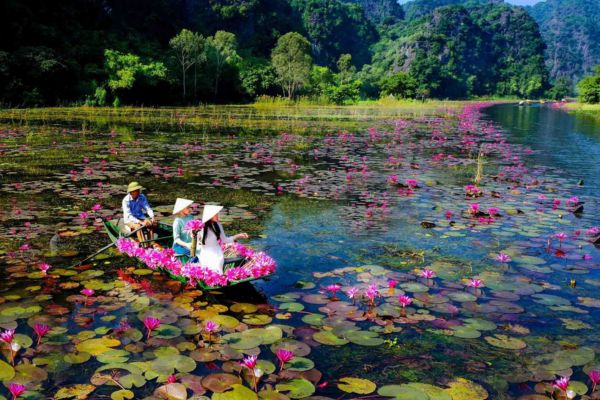
The Water Lily Season (September to November): Once the summer heat breaks and the autumn sets in, the flooded waters bring a different kind of magic. While the rice is gone, the rivers and shallow ponds around Tam Coc bloom with delicate purple and pink water lilies.
Regardless of the month, the time of day matters most. Do not take the boat at 1:00 PM. The sun beats down directly onto the metal boats, and it can be uncomfortably hot. Go early in the morning (around 7:30 AM to 8:30 AM) when the mist is still clinging to the mountains and the big tour buses from Hanoi have not arrived yet. Alternatively, go late in the afternoon (around 4:00 PM) to catch the soft golden hour light.
Practical Logistics for the Boat Ride
To ensure you actually enjoy the two hours on the water, come prepared:
Sun Protection: The boats do not have roofs. Even on cloudy days, the UV index in Vietnam is high. Bring a wide-brimmed hat, sunglasses, and sunscreen.
An Umbrella: This works for both sudden tropical rain showers and intense sun.
Water: Bring your own reusable water bottle from the hotel.
Tipping: Tipping is not strictly mandatory, but it is highly appreciated and customary. For a two-hour journey, a tip of 50,000 to 100,000 VND per boat (handed directly to your rower at the end) is a respectful way to say thank you for the intense physical labor.
Final Thoughts
A boat ride through Tam Coc is not a pristine, highly sanitized theme park ride. It is a genuine slice of northern Vietnamese life, complete with its chaotic charm, its stunning natural geometry, and its hardworking people.
If you embrace it for what it truly is – a slow, quiet float through an ancient agricultural valley – it will undoubtedly be one of the most memorable afternoons you spend in our country. We look forward to welcoming you to the river.