
Hello fellow travelers and wildlife enthusiasts. When planning a trip to Ninh Binh, most itineraries focus heavily on the serene boat rides, the golden rice paddies, and the ancient temples. However, as a local guide who spends everyday navigating these limestone valleys, I want to introduce you to a profound secret hidden high up in the jagged cliffs.
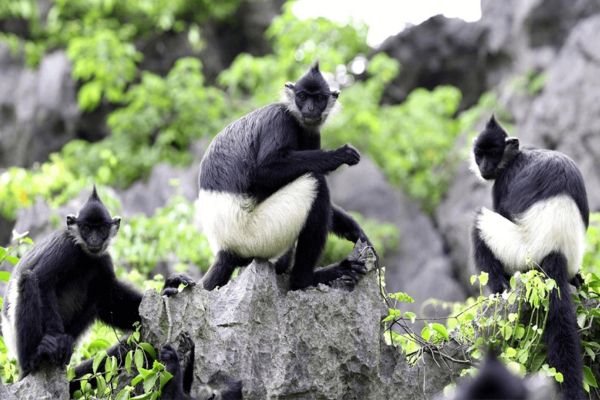
Deep within the primary forests of our region lives one of the rarest creatures on the entire planet. Today, we are going to explore the fascinating world of the Delacour’s Langur. Here is a detailed, factual look at this incredible animal and its dramatic fight for survival.
The Rare Jewel of Vietnam
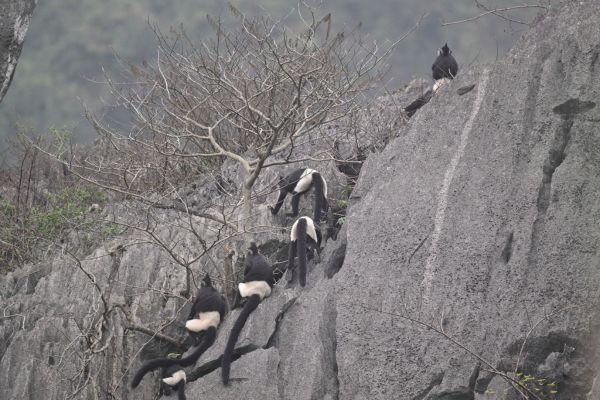
The Delacour’s Langur is a large primate species that belongs to the Old World monkey family, scientifically known as Cercopithecidae. Classified within the Primates order, its official scientific name is Trachypithecus delacouri. This name was specifically chosen to honor Jean Théodore Delacour, a prominent French-American ornithologist.
This magnificent creature is strictly endemic to Vietnam, meaning it does not exist in the wild anywhere else in the world. Due to its extreme rarity, it has been officially listed in both the Vietnamese and global Red Data Books as a species requiring urgent protection. Tragically, conservationists currently rank it as one of the top five most globally threatened primate species.
Distinctive Physical Characteristics
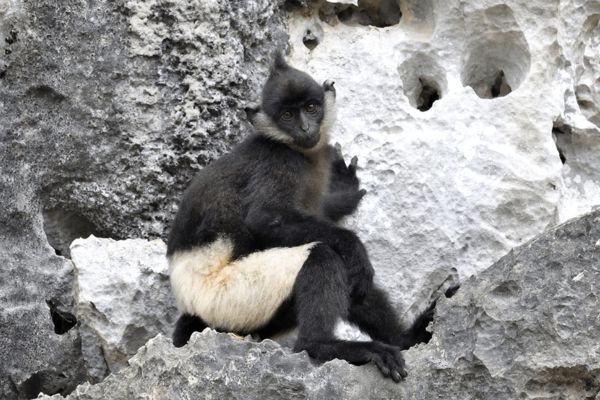
If you are trekking with binoculars, identifying this primate is quite straightforward due to its striking physical markings.
Adult individuals are relatively large, typically maintaining a body weight ranging between 8.1 and 9 kilograms.
When measuring the length of their head and body combined, they span from 0.46 to 0.665 meters.
They proudly sport a distinctive crest of black hair situated right on the top of their heads.
A rather wide band of white hair runs prominently along both of their cheeks, extending upward toward their ears.
The fur on all of their limbs is completely black.
Their most iconic feature is the prominent patch of white fur located on their rump, which stretches all the way down to their thighs and the base of their tail.
They have evolved with remarkably long limbs, which help them navigate their rugged environment.
Their tail is actually longer than their entire body, and it is covered entirely in black hair.
In terms of diet, they are strict herbivores. Their daily food intake consists primarily of tree shoots, various leaves, and wild fruits found in the canopy.
A Specialized and Shrinking Habitat
The Delacour’s Langur is one of the very few primate species on earth that has adapted almost completely to a rugged limestone mountain environment. They exclusively inhabit old-growth and primary forests situated on rocky terrains that feature numerous caves. These steep limestone ridges serve a dual purpose: they provide dense endemic vegetation for foraging, and the deep caves act as a secure sanctuary against predators.
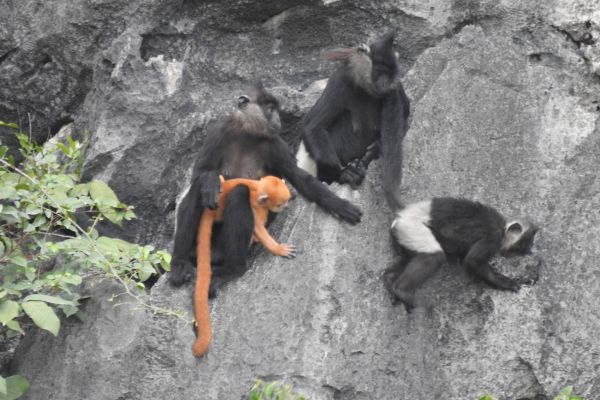
However, this extreme reliance on a highly specialized habitat makes them incredibly vulnerable. Whenever their living environment is fragmented, their survival is instantly threatened. According to historical data from the 1990s, populations once thrived abundantly across the continuous limestone ridges stretching all the way from Van Long in Ninh Binh to Ron Rong in Hoa Binh. Unfortunately, rampant hunting and trapping rapidly eradicated this widespread presence.
The population has suffered a devastating decline of over 80% throughout the last four decades. This drop is largely attributed to severe hunting pressures, where the animals are captured for the illegal pet trade, consumed as food, or used in traditional medicine practices. Furthermore, their natural habitats face severe degradation driven by the illegal encroachment on natural forest lands for agricultural expansion, as well as the destructive impacts of mineral extraction, stone mining, and commercial logging.
The Dramatic Story of Rediscovery
The survival story of the Delacour’s Langur reads like a thrilling adventure. Over 30 years ago, the global scientific community widely believed that this specific species was completely extinct. For a long time, the only remaining evidence of its existence was a postage stamp featuring its illustration. This stamp was issued by Vietnam Post in 1959 and a copy was preserved in the Federal Republic of Germany.
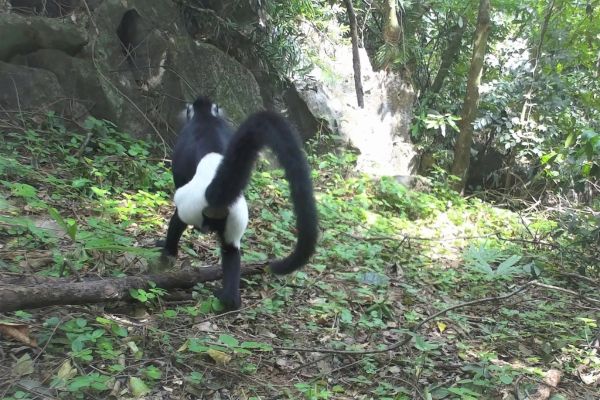
The conservation world was profoundly shocked when a Polish biologist, conducting research within Cuc Phuong National Park in Ninh Binh, unexpectedly captured a photograph of a living individual. This groundbreaking information was immediately dispatched to international wildlife conservation organizations.
On a late winter day in 1991, three dedicated men from the Frankfurt Zoological Society (FZS) in Germany traveled to Vietnam to investigate. Among them was Dr. Tilo Nadler, who arrived carrying a massive amount of luggage, determined to track this precious primate. Every single day, they ventured deep into the forest, setting up tents and stubbornly waiting out on the vertical limestone cliffs. The local ethnic communities were astonished by the sight of these foreigners carrying heavy cameras, climbing towering trees, and staring intently at the white cliffs across the valleys.
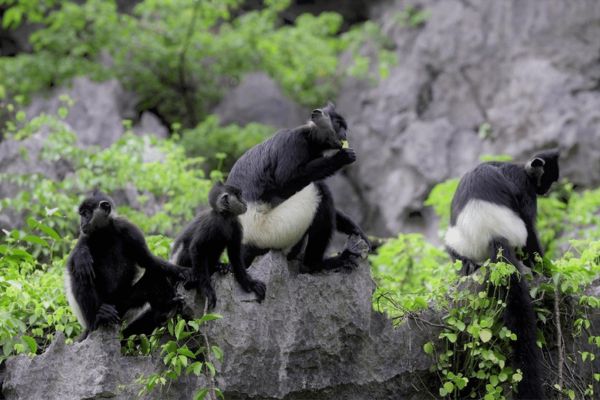
For many exhausting months, this cross-continental expedition lived roughly in the forest, surviving with only faint traces to guide them. It took nearly an entire year of relentless effort before Dr. Nadler’s cameras finally “trapped” the first clear images of the Delacour’s Langur, a species the world thought was lost forever. Standing amidst the majestic mountains of Cuc Phuong, they let out shouts of joy that startled the local villagers. From that historic moment, their existence in the wild was officially and undeniably confirmed.
Following this rediscovery, the very first Endangered Primate Rescue Center (EPRC) in Vietnam and Indochina was successfully established. Thanks to the tireless efforts of EPRC experts and passionate volunteers, the population began to grow steadily and stabilize across the limestone mountain ranges in Ninh Binh, Ha Nam, Hoa Binh, and Thanh Hoa provinces.
Current Distribution and Population Statistics
Today, comprehensive surveys reveal a highly fragmented distribution. An initial investigation by the Frankfurt Zoological Society indicated that the global population was restricted entirely to Vietnam, consisting of just over 200 individuals scattered across 18 isolated locations in Ninh Binh, Ha Nam, Hoa Binh, and Thanh Hoa.
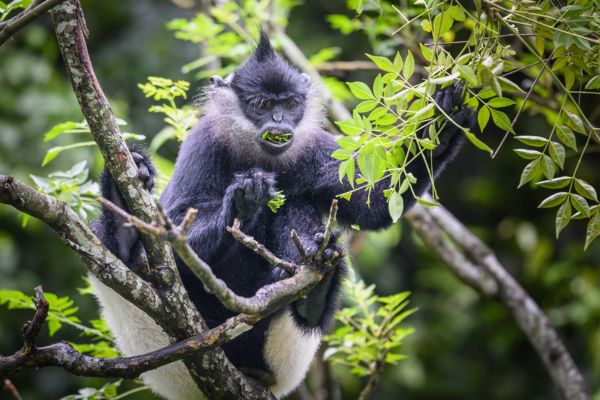
Currently, Vietnam focuses its primary conservation efforts in two major strongholds: the Van Long Wetland Nature Reserve and Cuc Phuong National Park.
Van Long Nature Reserve: This location currently hosts the absolute largest population in the country. The combined area of Van Long and the Dong Tam forest in Lac Thuy holds between 304 and 336 individuals. A highly advanced survey conducted in 2024 by the organization ThreeMonkeys, utilizing drone technology, confirmed that the Van Long area specifically contains 48 distinct groups totaling exactly 336 individuals.
Kim Bang – Tam Chuc: The protective forests in the Kim Bang region have been identified as the crucial second-largest habitat, playing a vital role in the ecological network. While some records indicate a population of 175 individuals, an investigation by Save Vietnam’s Wildlife noted that this specific zone houses 18 groups comprising approximately 118 individuals.
Other Small Populations: The species also maintains a fragile presence in the forested areas of Yen Mo, Tam Diep, and Bim Son. Pu Luong Nature Reserve in Thanh Hoa represents one of the most critically endangered subsets, with a mere 5 to 7 individuals remaining.
The Miracle Recovery in Huong Son
One of the most inspiring recent developments has occurred in the Huong Son forest area in Hanoi. The Delacour’s Langur is classified as Critically Endangered by both the International Union for Conservation of Nature (IUCN) and the Vietnam Red Data Book. Although Huong Son was a historical habitat, no wild populations had been recorded there for several decades.
In 2020, the Center for Nature Conservation and Development (CCD) partnered with the Hanoi Forest Protection Department to survey the area. Miraculously, in 2022, the expert team rediscovered 5 individuals in the Huong Son forest, an area where they were presumed locally extinct.
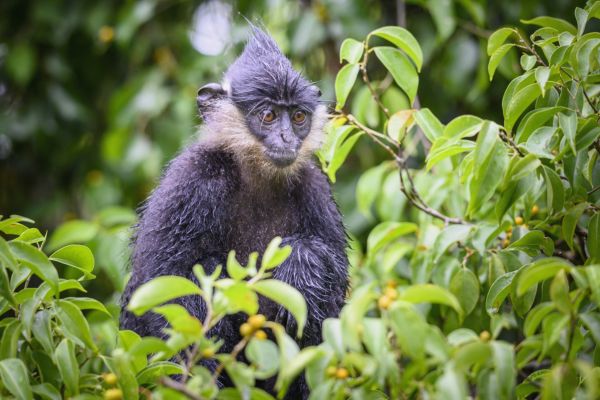
Following this discovery, CCD swiftly coordinated with local authorities, the Hanoi Forest Protection Department, the Management Board of Hanoi Protection and Special-Use Forests, and local communities. Together, they formed community protection squads to regularly patrol and monitor the population and their habitat.
The results have been overwhelmingly positive. By 2025, using rigorous field surveys, camera traps, and thermal-imaging drones, CCD and local partners officially confirmed that the Huong Son population has grown to 2 distinct groups containing about 15 individuals. The largest of these groups contains more than 12 individuals, importantly including newly born infants from 2024 and 2025.
Mr. Nguyen Manh Ha, the Director of CCD, stated that documenting these newborn langurs is critical evidence proving that the Huong Son population is actively reproducing and demonstrating clear signs of recovery. This success highlights the effectiveness of continuous community and governmental protection efforts.
Protecting the Future
Despite recent victories, conservationists emphasize that strict measures must continue. It is imperative to rigorously protect their final remaining habitats and heavily enforce laws against illegal hunting and domestic or international wildlife trade. Additionally, widespread educational campaigns are necessary to raise community awareness regarding the protection of the Delacour’s Langur, particularly in regions adjacent to their habitats.
If you are visiting Ninh Binh, joining a responsible eco-tour to places like the Van Long Nature Reserve or the Rescue Center in Cuc Phuong is the best way to support the ongoing survival of this magnificent species.